



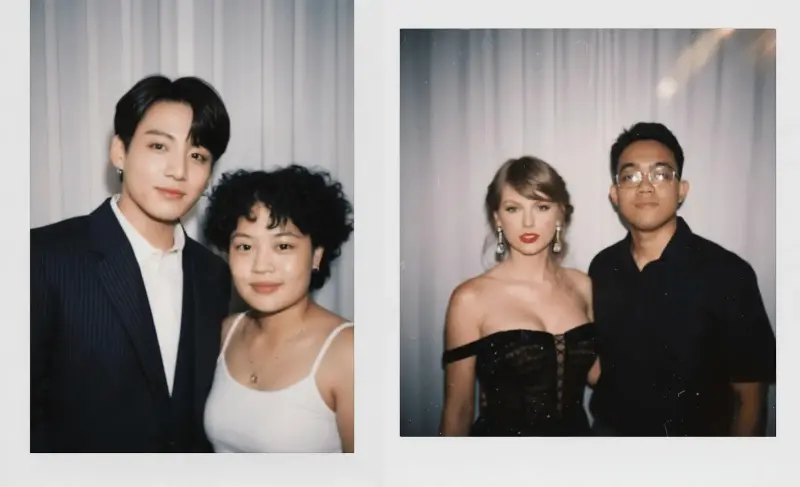
MANILA, Philippines – Have you been seeing your Facebook friends receiving a kiss from Jungkook from BTS, or a relative hugging Taylor Swift?
Your eyes aren’t deceiving you, but reality is — these are actually AI-generated Polaroid photos made with Google Gemini. And yes, they’re going viral.
It’s a universal truth that fandoms love collectibles — from t-shirts and tote bags to pins and keychains — that, when seen, felt, or used, evoke the same feeling when they listen to an idol’s music, watch their film, or reminisce about the nostalgia that filled their hearts.
Now, with the power of technology, fans can customize them.
Forget star signs, this Gemini brings the stars to you
Google Gemini is an artificial intelligence (AI) model that has grown a community of users from asking weather checks and homework help to requesting digital Polaroids with celebrities.
These AI-generated photographs are instantly crafted in just a few minutes, needing only your instructions and two images (one of you and one of the celebrity), which the AI stitches together into a fan-tastically real meet-and-greet.
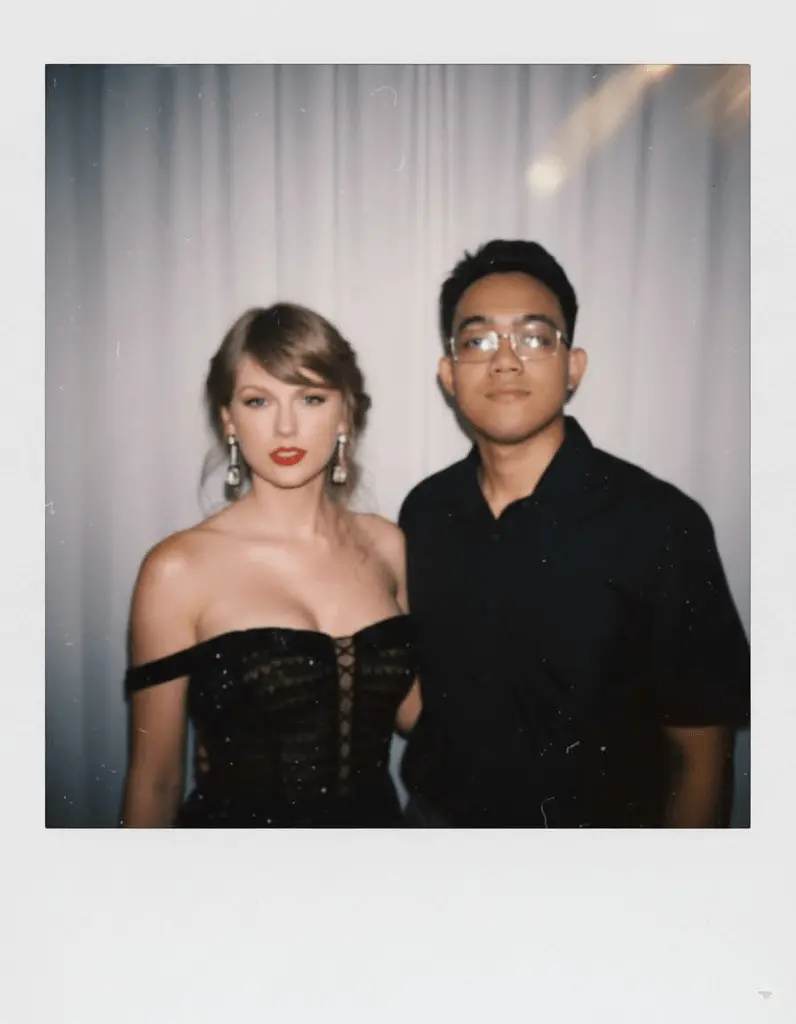
The internet loves these AI polaroids because they look so real, but the law hasn’t exactly caught up to the trend. Behind every dreamy selca with Jungkook or candid snap with Taylor is a copyrighted photo (usually owned by the photographer) and a celebrity with image rights of their own.
When ‘kilig’ comes with risks
As the Free Press Journal noted, “creating Polaroids with celebrities without consent could violate image rights or lead to accusations of false association.” While people are freely sharing these edits online, there’s a chance they could be mistaken for real photos or even misused in ways the celebrity didn’t agree to.
This is where deepfakes come in. Deepfakes are AI-generated or digitally altered media — videos, photos, voice recordings, and more — that make it look as though someone said or did something that never happened.
While AI polaroids are more harmless than most deepfakes, they stem from the same technology that can also be used to produce deceptive content. Just as Gemini can be prompted to have Taylor right next to you, AI tools can just as easily be used to distort the celebrity’s image into a misleading political representation.
The risk goes beyond manipulation, too. Another concern is that the more realistic these snapshots appear, the more likely people are to fixate on how AI portrays their looks, down to their faces and bodies. In a country where fandom fundamentally shapes how people gather, spend, and express themselves, it’s another reminder that technology also reshapes the mirror in which we see ourselves along the stars we celebrate.
To click or not to click?
Does that mean you can’t make a Gemini Polaroid at all? Not really — feeds are still flooded with this trend, and AI has never stopped evolving in our digital spaces. From Instagram reels to TikTok videos, AI-generated content is only expanding into an ever-wider online wilderness that you might even find yourself getting lost in.

But just as an adventurer needs a map to navigate an unfamiliar jungle, a user needs the awareness and research to move through these platforms safely. Understanding how AI works and learning how to recognize what is real and what is fabricated (which is never an easy task) helps ensure the fun doesn’t turn into harm.
Through regular fact-checks, Rappler has monitored the rise of AI-generated deepfakes. Here are some articles outlining strategies for spotting them: Truth, tools, and trust: Responsible use of AI in changing media (August 12, 2025), Philippines faces rising AI-driven disinformation (December 13, 2025), How to spot a deepfake video: Motivation, telltale signs, the larger narratives (September 30, 2024), and Deepfakes: How to empower youth to fight the threat of misinformation and disinformation (February 10, 2024).
These polaroids may be cute and kilig-worthy, and there’s no direct harm in pretending you’re the girlfriend of Harry Styles or you’re reunited with Rosé. In this age of deepfakes and disinformation, using AI tools like Gemini is generally harmless when used with care and caution.
At the end of the day, when you tweak the prompt, share the results, and move on, AI stays as a tool for creativity, not confusion. By staying aware of the risks, users can hold onto a steady compass in a technological landscape filled with disinformation and distorted deepfakes. – Rappler.com
Jaella Magno is a Rappler intern studying AB Literature major in Creative Writing at De La Salle University.